Greek Epics LIII: Argonautica Book 4, or Who is the Real Hero?

Medea rocks, and I finally let loose on the Homer comparisons.

Discussion Prompts
  1. Medea or Jason? Why?
  2. Which translation did you read? Pros? Cons? Would you recommend it?
  3. What role does divine intervention play in this epic? Does it help or hurt the story?
  4. What do you think of where the Argonautica ends?
  5. Is anyone really a hero in this epic? Why or why not? If yes, who?
  6. The Argonautica is significantly shorter than its predecessors. Would it benefit from a 24-book treatment? Why or why not?
  7. AP Credit: Discuss serpents in Mediterranean mythology.
Greek Tragedy XXXIII: Euripides’s Bacchae, or, Dude, Dionysos Gets Dark

Whatever you do, don’t question Dionysos’s divinity!

Discussion Prompts
  1. Traditionally, maenads are women. How would you cast the chorus of maenads if you were directing today?
  2. Some of the humor in this play originally derived from Pentheus being dressed up as a woman. How would you handle that scene if you were directing this play today?
  3. Plus the usual directing questions: Dream cast? Setting? Vision?
  4. What does this play have to say about new religions?
  5. What does this play have to say about civilization? What does it mean to be “civilized”?
  6. AP Credit: Compare/contrast the rise of cult of Dionysos with the rise of Christianity.
  7. Dionysos is the god of wine and the god of theatre. Why is this a logical combination?

Greek Myth XXV: Hymn to Selene, or That Other Moon Goddess

In today’s episode, we meet the goddess of the moon. No, not that one. No, not that one either. You know, Selene.

Discussion Prompts
  1. Why do you think the poet describes Selene as having wings when there is no other place she is described or depicted this way?
  2. If you were making a new lunar calendar today, how would your calendar months correspond to the phases of the moon? Why?
  3. Why do you think Selene is overshadowed by Artemis, Hekate, and Persephone, who are also associated with the moon?

Greek Epics LII: Argonautica Book 3, or How Medea Met Jason

Long before the events she’s most famous for, Medea was just a girl, looking at a boy, telling him she loved him.

Discussion Prompts
  1. Do you think the story would turn out differently if Medea hadn’t been shot by Eros? Why/how or why not/how not?
  2. What is the importance of Chalciope’s relationship to Telamon and Augeas?
  3. AP Credit: Book 3 begins with an invocation of the muse Erato. Why is this appropriate?
  4. What do you think of Jason? Medea? Any other character that strikes your fancy?

Roman Comedy XV: Plautus’s Epidicus, or If Gilbert & Sullivan Met Plautus

Gilbert and Sullivan wish they’d come up with plots as complicated as the one in Plautus’s Epidicus.

Discussion Prompts
  1. If directing this play today, how would you handle the complicated plot?
  2. The four women are some of the cleverest characters in this play. Discuss.
  3. Why isn’t Periphanes aware that the soldiers are returning from Thebes?
  4. The typical directing questions: vision, setting, dream cast, etc.?

Greek Epics LI: Argonautica Book 2, or I Don’t Think We’re in Greece Anymore

The Argonauts continue their journey in Book 2 of the Argonautica.

Okay, the sound quality isn’t great, but this is where my brain goes whenever I hear (or say) the phrase “Run away!”
The Phineas we meet in today’s episode is quite the opposite, but of course he makes me think of this Phineas.
Discussion Prompts
  1. AP Credit: Compare/Contrast Herodotus and Book 2 of the Argonautica.
  2. What does the character of Phineas tell us about age versus youth?
  3. In Book 1, the Argo lost three crew members. In Book 2, it gains seven new ones. Is that enough to make up for the caliber of the three who were lost? Why or why not?
  4. What do you think about our heroes so far? Do you have a favorite? If so, who and why?

Greek Tragedy XXXII: Euripides’s Orestes, or Mourning Does Not Become Orestes

We aren’t quite done with variations on the story of Orestes, as we see in today’s play from Euripides.

I’ve told you that my brain makes fun connections. Here’s where my brain went when I was putting together today’s episode.

The resolution isn’t great, but it’s the song that I thought of when Electra and the Chorus are trying not to wake Orestes.
I was going to share a performance video, but they were all so serious, and I think this show is best if nothing is taken seriously. So how does my brain work? I say the word “grovel” and immediately start singing it…
Discussion Prompts
  1. Why is the focus on the murder of Clytaemestra and not Aegisthus?
  2. AP Credit: Discuss the theme of justice in all of the iterations of the Orestes myth written by the Greek tragedians.
  3. What do you think about Helen in this play? Menelaos? Orestes? Electra?
  4. If you were directing this play today, how would you handle it? Setting, theme, vision, cast, etc. Why?
  5. Helen, Castor, and Polydeukes are all now on Olympos according to Apollo. Where do you think Clytaemestra is? Why?

Greek Myth XXIV: Hymn to Helios, or This God Is Hot

Today we cover Homeric Hymn 31, about that hottest of the gods, Helios.

Discussion Prompts
  1. Who do you think Euryphaëssa is?
  2. This hymn appears to be the prelude to an epic. What do you think that epic was about?
  3. Hyperion, Helios, and Apollo are all sun gods. Why do you think there was so much redundancy in the function of Greek gods?

Greek Epics L: Apollonius of Rhodes & Argonautica Book 1, or Meet the Crew

In today’s episode, we join Jason and a bunch of his friends as they set off in their boat, the Argo, in Apollonius of Rhodes’s The Argonautica.

Discussion Prompts
  1. AP Credit: Discuss the women presented in Book 1 of the Argonautica.
  2. AP Credit: Compare/Contrast Pelias and Oedipus.
  3. What do you think the history is behind the myth of Lemnos?
  4. What do you think about the question over who will captain the Argo (Heracles vs Jason)?
  5. What do you think about this motley crew of heroes and demigods?

Roman Comedy XIV: Plautus’s Curculio, or My Daughter! My Sister!

In today’s episode, we cover the shortest of Plautus’s surviving plays.

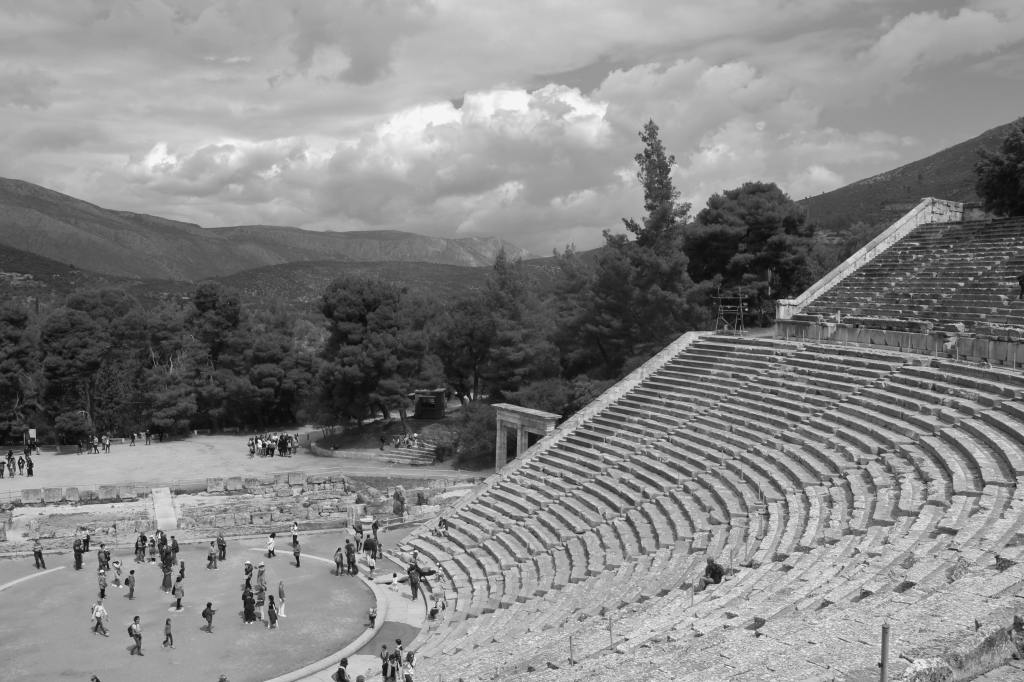
The theatre at Epidaurus — stand on that circle in the middle for the most perfect acoustics
Discussion Prompts
  1. AP Credit: What does this play have to say about “modern” medicine (modern being the time in which the play was written)?
  2. This is the shortest play we have by Plautus. Does this make it better or worse than the others we’ve read? Why or why not?
  3. Were Palinurus and Curculio played by the same actor? Does it matter? Why or why not?
  4. If you were directing today, would you follow the ancient tradition of approximately three actors playing multiple roles? Or would you assign one actor to each role? Why?
  5. Why does it matter that Planesium is a free-born woman?
Design a site like this with WordPress.com
Get started