Greek Epics XXXVII: Odyssey Book 12, or Tiresias Warned You

How many people have to tell you not to eat the Cattle of the Sun? We’ll find out in Book 12 of The Odyssey.

Discussion Prompts
  1. What would you do if you were Eurylokhos and the rest of Odysseus’s men? Starve? Or eat Helios’s cattle?
  2. Do you trust Odysseus? Why or why not?
  3. Why is there more glory in death at sea than death by starvation?
  4. AP Credit: What might the monsters Skylla and Kharybdis represent?

Greek Tragedy XXV: Euripides’s Heracles, or Not to Be Confused with Disney’s Hercules

In Disney’s Hercules, we see how Meg and Herc meet and fall in love. In Euripides’s Herakles, we see how Megara and Herakles… well… Let’s just say that the ending isn’t pretty…

Yeah, Meg. You probably shouldn’t have said you’re in love…
Discussion Prompts
  1. What does this play have to say about the role of the gods in the lives of mere mortals?
  2. This play consists of two (or maybe even three) disparate sections. How do you link them together into a unified whole?
  3. If you were directing, where and when would you set it? Who would you cast? Why?
  4. If you were directing, would you have Amphitryon exit at the end of the play? Why or why not?
  5. What do you like about this story? Hate? Why?

Greek Myth XVII: Hymns to the Dioskouroi, or Who Else is a Gemini?

Today we cover the Homeric Hymns numbered 17 and 33, dedicated to a certain pair of twins that happen to be the star-sign for a certain podcast host.

Discussion Prompts
  1. Kastor or Polydeukes? Why?
  2. What’s your sign? (lol — seriously, this is a question that my Italian teacher made sure we knew because he wanted us to be prepared to get hit on when we were in Italy)
  3. Do you think Kastor and Polydeukes were minor gods who were elevated or major gods who were demoted? Why?
  4. Who is their father? Why? Feel free to go on a deep dive into comparative mythology. Why not?

Greek Epics XXXVI: Odyssey Book 11, or Who Ya Gonna Call?

Odysseus talks to a lot of ghosts, no busting required.

Ghost Hug GIF - Ghost Hug YouCantFeelItButItsThere GIFs
I couldn’t resist…

Also, I used to have this comic strip pinned to my bulletin board back when I had a real office with a bulletin board. It still makes me giggle. ‘Cause I’m that kind of nerd.

Discussion Prompts
  1. AP Credit: Liminality. And… go!
  2. How do you think Book 11 might have been different if written by a woman? Why?
  3. Which meeting is your favorite in this book? Alternatively, which ghost do you wish Odysseus had spoken to? Why?
  4. How do you feel about Odysseus now? Good? Bad? Indifferent?
  5. What do you think is going to happen next? No spoilers if you’ve already read!
  6. AP Credit: Discuss how Odysseus’s audience may color how he is telling the story of what happened to him between Troy and Phaiakia.

Roman Comedy VII: Plautus’s Persa, or What Just Happened?

Remember everything I told you about Roman Comedy’s use of stock characters? Well, you can forget everything I told you about Roman Comedy’s use of stock characters. In Persa, Plautus breaks that form.

A selection from Persa in modern dress
Discussion Prompts
  1. If you were directing this play today, how would you handle any issues of orientalism?
  2. How does the daughter fit the virgo model? And how does she break it?
  3. In most Roman comedies, the majority of the characters are free. What might this play say given the fact that the majority of the characters are slaves?
  4. If you were directing this play today, how would you help the audience keep everything straight? Would you try to use the upending of tropes as an unsettling feature? Why or why not?
  5. What biases do you need to check? No judgement. We can’t learn to look beyond our biases if we don’t acknowledge that they exist. I am strongly biased towards feminism. Shocking, I know. But that does mean I need to do better at my gut reaction when I encounter people who are not also feminists. What about you? An excellent way to learn more about your biases is to take one (or a dozen) of Harvard’s implicit bias tests. (That’s how I learned that I really do have a very strong bias towards feminism. Again. Shocking. I know.) I’ll be here when you’re ready to share.

Greek Epics XXXV: Odyssey Book 10, or Men are Pigs

Odysseus and his men visit a few more islands. Not every island results in someone’s death, but for the most part, it’s not going very well.

Discussion Prompts
  1. Odysseus doesn’t trust his men with the bag of winds. Is he justified in this lack of trust? Why or why not?
  2. If you were Aiolos, would you give Odysseus a second bag of winds? Why or why not?
  3. What are the odds of encountering two races of cannibalistic giants?
  4. Why do you think Kirkê has a penchant for turning men into animals?
  5. Why do you think Odysseus’s men turn into swine?
  6. If you were in my ATYP class, which book of The Odyssey was your group assigned to analyze?
  7. What are your thoughts on our titular hero so far? Do you trust him?

Greek Tragedy XXIV: Euripides’s Electra, or An Ancient Greek Rashoman?

Each of our tragedians tackled the story of Orestes and Electra. In today’s episode, we get Euripides’s take, and as one should expect from the most depressing of the three, it is bloody.

Discussion Prompts
  1. Which version of this story do you like best? Why?
  2. What does Klytaemestra tells us about motherhood?
  3. AP Credit: Discuss nobility as depicted in this play.
  4. Why do you think Aegisthus has no speaking role in this play?

Greek Myth XVI: Hymn to Askelpios, or I Guess We Know Who His Parents Are Now

Today we have another short Homeric Hymn in #16: Hymn to Asklepios.

When I think of Asklepios, I think of the Tiber Island in Rome. I know, I know. This episode is about a Greek source, not a Roman one. But this is the temple to Asklepios, or at least the location of a temple to Asklepios that I think of. I love this photo because you can see how the Romans sculpted the natural island to look like a boat. Image by LizzCallahan from Pixabay 
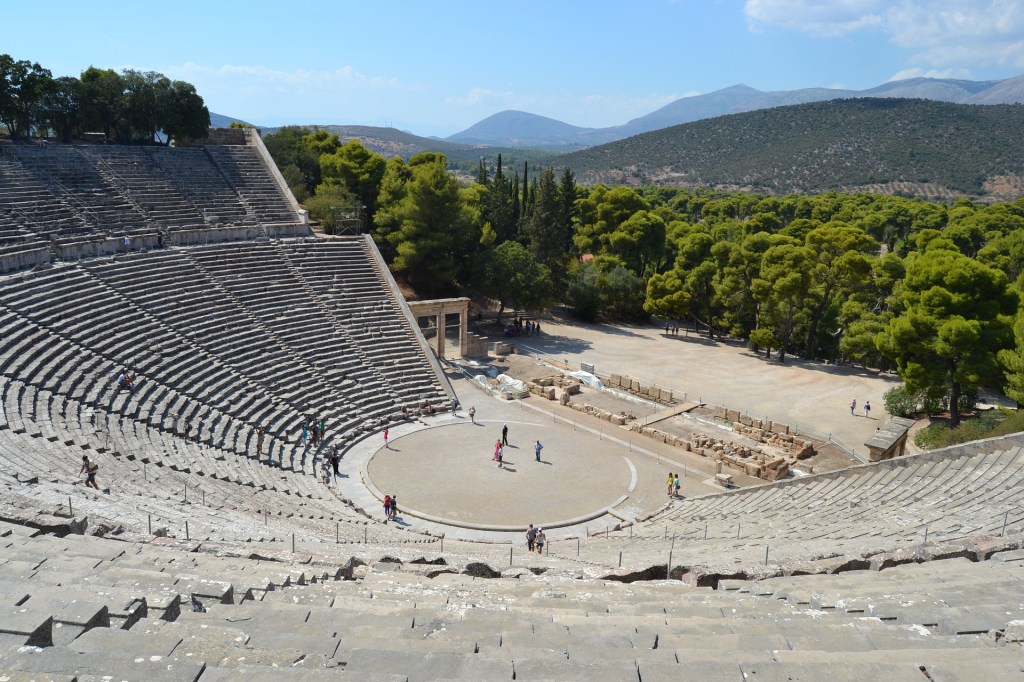
Here’s my favorite Greek… um… temple… to Asklepios. Okay, this is the theatre at Epidauros, not the temple to Asklepios, but this is another site where Asklepios was venerated, and this one actually is in Greece. And it is awesome. You can stand in the center of that stage and have a whispered conversation with someone in the top row. The acoustics are that perfect. Image by 1440602 from Pixabay 
Discussion Prompts
  1. AP Credit: Asklepios is a healer. He is also the son of a god and a mortal and was originally mortal. How do all of these details work together in a logical way?
  2. When you think of Asklepios, what do you think of? Why?

Greek Epics XXXIV: Odyssey Book 9, or Vizzini Told Me to Go Back to the Beginning

In Book 8, Alkinoös asks Odysseus to tell his tale, and in Book 9, that tale finally starts. This is probably what you were thinking The Odyssey would be about.

Discussion Prompts
  1. AP Credit: The mistake Odysseus’s men make with the Kikonês is not the original plunder; it is that they are too greedy. What does this say about ancient Greek values? Does this say anything about life today? How does this lesson translate to life today?
  2. The Lotos Eaters as a representation of drug addiction: Discuss.
  3. If you were Odysseus, would you have left the safety of the uninhabited island to plunder the Kyklopês? Why or why not?
  4. What do you think is in that alcohol Odysseus uses to get Polyphêmos drunk?
  5. What do you think of our hero so far? Why?
  6. Do you trust Odysseus? Why or why not?

Roman Comedy VI: Plautus’s Casina, or Where’s Waldo?

It’s episode 100! But nothing exciting happening here. Instead it’s a really weird play. Not Plautus’s finest. And not one that aged well.

We see a similar plot in A Funny Thing Happened on the Way to the Forum, so for a little fun:

Discussion Prompts
  1. How would you rewrite this play for a modern presentation?
  2. If you were directing this play today, how would you handle it? Setting? Cast? Vision? Why?
  3. Why do you think we never see either Casina nor Euthynicus?
  4. How would you tell this story from the perspective of either of our missing characters?
  5. AP Credit: The two matrons in this play are Myrrhina and Cleostrata. Discuss.
Design a site like this with WordPress.com
Get started